Attic Ventilation Standards:
The 1/300 Rule & Mold Prevention
The physics of passive airflow. Why installing a powered attic fan might be the worst mistake you can make for your mold risk.
Trusted Sources: This engineering guide references standards from the U.S. Department of Energy and Building Science Corporation.
In winter, your attic should be freezing cold. In summer, it should be hot. If your attic is warm in the winter, you have a ventilation failure.
When warm, moist air from your showers and breathing rises into a cold attic, it hits the freezing roof sheathing. The result is condensation (frost), which melts and rains down on your insulation, feeding mold colonies on the underside of your roof deck.
1. The Golden Ratio: Intake vs. Exhaust
Effective ventilation requires a continuous flow of air. It enters at the bottom (Soffit) and exits at the top (Ridge).
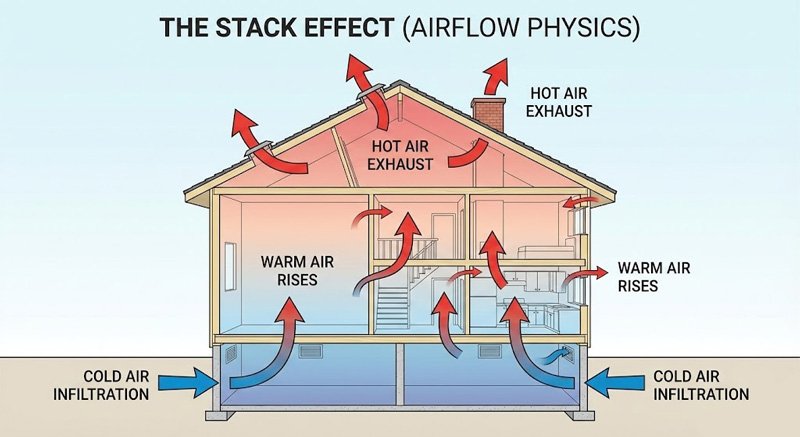
Your system must be balanced.
50% Intake (Soffits) + 50% Exhaust (Ridge Vents)
If you have exhaust (Ridge Vent) but no intake (blocked Soffits), the roof will suck air from inside your house to feed the vacuum, pulling moldy crawl space air up through the walls.
2. The “Power Fan” Paradox
Many homeowners buy electric or solar-powered attic fans to “suck the heat out.” Building scientists strongly advise against this.
Powered fans are too strong. They create Negative Pressure in the attic.
Because passive soffit vents usually can’t supply enough air to satisfy the fan, the fan starts sucking conditioned (AC) air from your living room through light fixtures and cracks. You end up paying to pump your expensive Air Conditioning into the attic, where it is vented outside.
3. What is “Attic Rain”?
This phenomenon occurs in cold climates. It is often mistaken for a roof leak.
“If a customer calls me in February saying their roof is leaking, 95% of the time it is ‘Attic Rain.’ I go up there, and the nails are covered in frost. It’s not a roof problem; it’s an air-sealing problem. The warm house air is leaking into the attic and freezing.”
- The Cause: Warm, humid air leaks from the house into the attic.
- The Effect: It freezes onto the nails and plywood of the roof deck.
- The Damage: When the sun hits the roof, the frost melts instantly, “raining” onto the insulation below. This creates black mold on the plywood sheathing (typically Cladosporium).
4. The 1/300 Calculation Rule
International Building Code (IBC) requires a specific amount of ventilation based on your attic’s square footage.
Calculate the floor area of the attic.
Example: 1,500 sq ft.
1,500 ÷ 300 = 5 sq ft of Net Free Area (NFA).
You need 2.5 sq ft of Intake and 2.5 sq ft of Exhaust.
5. The Insulation Baffle Mistake
The most common cause of mold in newer homes is blocked soffits.
When blowing in new insulation, contractors often cover the soffit vents by accident. Air can no longer enter the attic. To prevent this, you must install Rafter Baffles (pink or blue foam chutes) that create a tunnel for air to travel over the insulation.
| Feature | Passive Ridge Vent | Powered Fan | Box/Turtle Vents |
|---|---|---|---|
| Airflow | Continuous (Silent) | Aggressive (Depressurizing) | Localized |
| Maintenance | Zero | Motor Failure | Check for Birds |
| Mold Risk | Lowest | High (Suction) | Medium (Dead spots) |