The chemistry of Sodium Hypochlorite explained. Why bleaching porous surfaces like drywall often makes the infestation come back stronger.
Trusted Sources: This analysis aligns with remediation standards from the EPA and OSHA.
Bleach does not kill mold on porous surfaces. It only bleaches the color, leaving the roots intact to regrow.
1. The Chemistry: Why Bleach Fails
To understand why bleach fails, you must understand the molecular structure of fungal roots (hyphae) versus the structure of bleach (Sodium Hypochlorite).
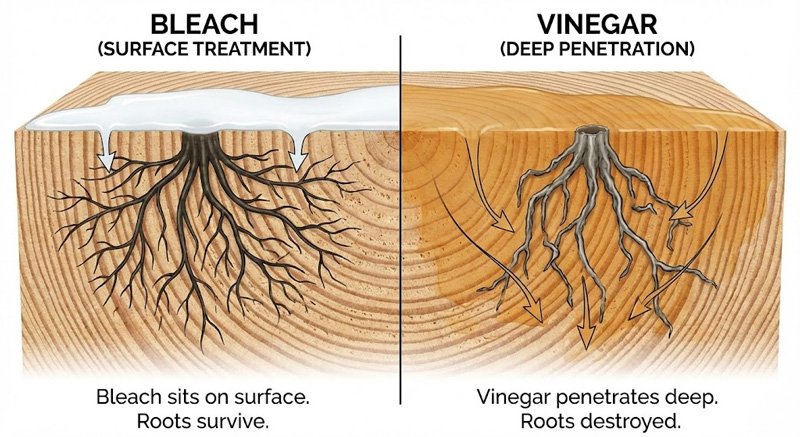
Chlorine bleach has a high Ionic Surface Tension. This means the chemical molecules are “too large” and too tightly bonded to penetrate the microscopic pores of drywall or wood.
Imagine trying to push a basketball through a chain-link fence. The ball (Bleach) sits on the surface, while the wind (Water) passes right through.
When you spray bleach on black mold:
- The Chlorine stays on the surface, burning the “leaves” of the mold (removing the color).
- The Water separates and soaks deep into the drywall, watering the roots.
The Result: The mold thinks it is being attacked, so it uses the new water to grow back aggressively—often within 48-72 hours.
2. The “90% Water” Problem
Household bleach (Clorox) is typically 3-6% Sodium Hypochlorite and 94% Water.
Mold requires moisture to thrive. By dousing a porous wall with a solution that is mostly water, you are essentially “feeding” the deep root structure. This leads to a phenomenon known as the “Re-Bloom,” where the mold returns darker and wider than before.
3. OSHA & EPA Warnings
This is not just internet theory. The major US regulatory bodies specifically advise against using bleach for remediation.
— Occupational Safety and Health Administration (OSHA)
— Environmental Protection Agency (EPA)
4. What to Use Instead?
If bleach is out, what actually works? You need an antifungal that has low surface tension (penetrates) or effectively lyses the cell membrane.
“We only use ‘botanical’ disinfectants (like Thymol) or hydrogen peroxide in residential jobs. The reason isn’t just effectiveness; it’s liability. If a client gets sick from chlorine fumes we left behind, that’s a lawsuit. Vinegar and Thyme oil don’t carry that risk.”
Used by pros. Made from Thyme oil. It penetrates pores and kills 99.9% of fungi without toxic fumes.
Bubbles on contact. This oxidation reaction physically destroys the mold’s cell walls. Use a 3% to 10% solution.
The mild acid penetrates porous surfaces better than bleach. Kills ~82% of mold species.
A salt-based solution that dries on the surface, physically crushing the spores as it crystallizes.
5. The One Exception: Tile & Glass
Bleach is effective on Non-Porous Surfaces.
If you have mold on bathroom tile, a porcelain tub, or glass windows, bleach works fine. Because the roots cannot penetrate these hard materials, the chlorine can effectively kill the surface growth. Just be careful of the toxic fumes.
6. Summary Comparison
| Chemical | Kills Roots? (Drywall) | Toxic Fumes? | Pro Recommended? |
|---|---|---|---|
| Bleach | NO | YES (Severe) | NO |
| Vinegar | YES (Mostly) | NO | DIY |
| Hydrogen Peroxide | YES | NO | YES |