Is it hay fever or a structural problem? How to differentiate seasonal pollen reactions from Sick Building Syndrome using the “Rain Paradox.”
Trusted Sources: This report is based on clinical data from the American Academy of Allergy, Asthma & Immunology and the National Institutes of Health (NIH).
Millions of Americans suffer from chronic congestion and assume it is “just allergies” or seasonal hay fever. However, when symptoms persist through winter or worsen during rainy seasons, the cause is often fungal, not floral.
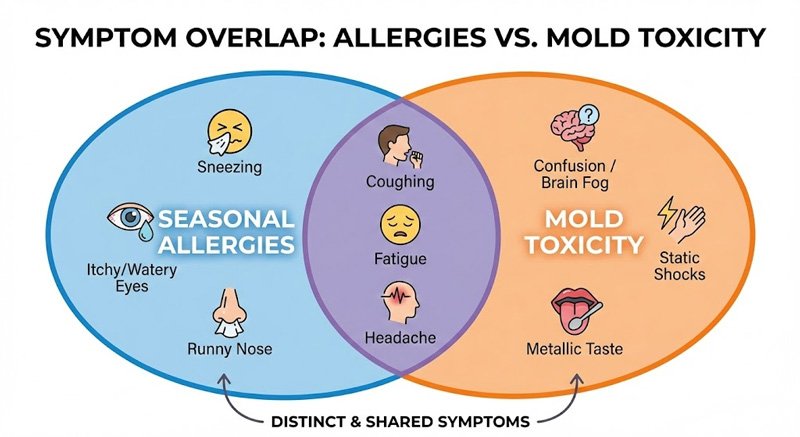
While both conditions trigger an immune response, distinguishing between Seasonal Allergic Rhinitis (Pollen) and Perennial Allergic Rhinitis (Mold/Dust) is crucial for effective treatment.
1. The Biological Difference
Both mold and pollen trigger the production of Immunoglobulin E (IgE) antibodies. However, the source and behavior of the allergens differ significantly.
Source: Trees, Grass, Ragweed.
Timing: Predictable seasons (Spring/Fall).
Location: Outdoor air entering indoors.
Behavior: Requires wind to travel.
Source: Fungal spores from decay.
Timing: Year-round (Perennial).
Location: Indoor colonization (Drywall/Carpet).
Behavior: Requires moisture/humidity.
2. The “Rain Paradox” Test
The easiest way to diagnose your home environment without a lab test is observing how you feel during a storm. This is known in environmental science as the “Rain Paradox.”
Pollen counts DROP during rain because the water weighs down the particles, washing the air clean. Most hay fever sufferers feel better after a storm.
Mold counts SPIKE during rain. The increase in moisture triggers sporulation (reproduction), releasing millions of spores into the home’s HVAC system. If you feel worse or more congested during rainy weather, it is a primary indicator of an indoor fungal reservoir.
3. Symptom Comparison Matrix
While both cause sneezing, key nuances in duration and location can reveal the source.
| Factor | Seasonal Allergy (Pollen) | Mold Exposure |
|---|---|---|
| Pattern | Worse on dry, windy days. | Worse on damp, rainy days. |
| Location | Worse outdoors / Open windows. | Worse indoors / Basement. |
| Duration | Ends with the season (Frost). | Year-round (Chronic). |
| Eyes | Watery, itchy eyes (classic). | Burning sensation. |
| Sleep | Nasal congestion at night. | Night sweats + Congestion. |
Check your zip code rainfall data →
4. The 4 Common Indoor Allergens
If you are reacting to your home, it is likely one of these four common genera. Unlike “Black Mold” (Stachybotrys), these are often invisible to the naked eye but highly allergenic.
[Image of Aspergillus]- Alternaria: Common in showers and damp window sills. Known to trigger severe asthma attacks.
- Cladosporium: The most common outdoor mold that hitches a ride inside on shoes and HVAC systems. Grows on fabrics and carpets.
- Penicillium: Usually blue or green. Grows rapidly on water-damaged wallpaper, insulation, and carpet.
- Aspergillus: Common in household dust. Can cause “Aspergillosis” (lung infection) in severe cases.
5. The “Vacation Test” (SBS)
The hallmark of Sick Building Syndrome (SBS) is the “location dependence” of symptoms.
Ask yourself: “Do I feel better when I go on vacation, or even when I spend a week at a friend’s house?”
“Patients with true pollen allergies usually find relief indoors with air conditioning. Patients with mold toxicity often report that their symptoms—specifically ‘brain fog’ and fatigue—vanish within 48 hours of leaving their primary residence. This ‘location-cure’ is a key diagnostic differentiator.”
- If you have Pollen Allergies, you will likely feel the same (or worse) if you go outside in a new location.
- If you have Mold Toxicity, symptoms often vanish within 24-48 hours of leaving the contaminated property, only to return immediately upon walking through your front door.
6. Diagnosis & Remediation
Antihistamines (Claritin/Zyrtec) can mask mold symptoms temporarily because they block the histamine response, but they do not stop the inflammation caused by breathing spores.
Steps to Confirm:
- Allergist Prick Test: Confirm if you are allergic to specific molds (Alternaria/Aspergillus).
- Monitor Humidity: Buy a cheap hygrometer. If your indoor humidity is consistently above 60%, mold is growing, even if you can’t see it.
- Audit the Home: Use our tool to check structural risk factors like crawl spaces and gutter issues.