How to legally write off mold removal as a “Medical Expense.” Understanding the Capital Expense Worksheet and the 7.5% AGI threshold.
Trusted Sources: This guide aligns with tax codes from the Internal Revenue Service (IRS) and Publication 502 (Medical Expenses).
The IRS generally considers home repairs to be “personal expenses,” which are not deductible. However, there is a major exception found in Publication 502 (Medical and Dental Expenses).
If the mold remediation is medically necessary to treat a specific illness (like asthma or mold toxicity), the cost can be deducted—but you must pass the “Capital Expense” math test first.
1. Eligibility Checklist
You cannot deduct mold removal just because it’s gross. It must be tied to a disease.
“The most common mistake clients make is trying to deduct mold removal on their ‘Schedule A’ without a specific medical diagnosis. The IRS will reject this every time. You absolutely need the ‘Letter of Medical Necessity’ from a physician dated before the work begins to be safe.”
- You have a diagnosed respiratory condition (Asthma, CIRS).
- Your doctor writes a prescription/letter stating: “Mold remediation is medically necessary to alleviate the patient’s condition.”
- The remediation is done specifically to treat the illness.
- Preventative maintenance (General cleaning).
- Aesthetic repairs (Painting over stains).
- Cosmetic upgrades done at the same time (New kitchen cabinets).
2. The “Capital Expense” Worksheet
Most home improvements increase the value of your home. The IRS says you can only deduct the portion of the cost that exceeds the increase in value.
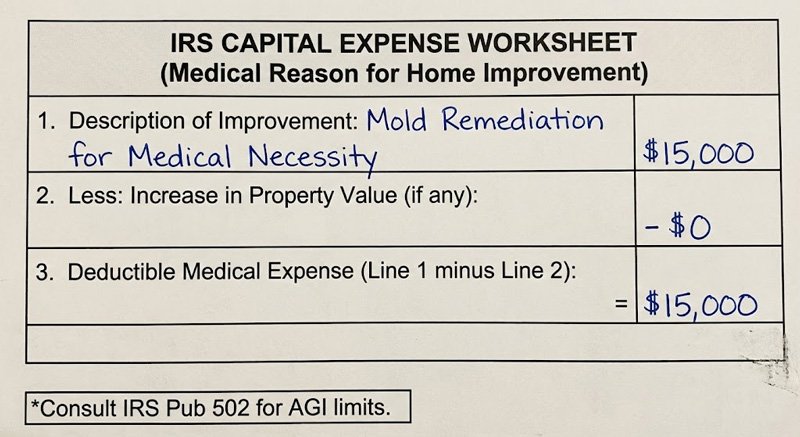
*Note: In most mold cases, the “Increase in Value” is zero because you are simply restoring the home to its previous condition, not upgrading it. This works in your favor.
3. The 7.5% AGI Threshold
Even if you pass the worksheet test, you can only deduct medical expenses that exceed 7.5% of your Adjusted Gross Income (AGI).
If your AGI is $100,000, your 7.5% threshold is $7,500.
If your remediation cost was $15,000, you can deduct:
$15,000 – $7,500 = $7,500 (Total Deduction)
4. Rules for Landlords (Schedule E)
If you own the property as a rental, the rules are much better. You do not need a doctor’s note.
- Repairs vs. Improvements:
- Repairs (Deductible Immediately): Cleaning mold, painting a stained wall. These go on Schedule E, Line 14.
- Improvements (Depreciated): Replacing the entire roof or HVAC system. These must be depreciated over 27.5 years.
5. Required Documentation
Do not file this deduction without a paper trail. If you get audited, you need:
- Letter of Medical Necessity: From your physician.
- Invoices: Itemized bills from the remediation company separating “cleaning” from “reconstruction.”
- Appraisal (Optional): If the IRS challenges the “Increase in Value,” an appraisal proving the home value didn’t go up protects you.