Tenant Rights Guide:
Mold & Habitability
A legal guide to landlord negligence. Understanding your rights to a safe environment, “Constructive Eviction,” and how to document damages correctly.
Trusted Sources: This guide cites housing statutes from the U.S. Department of Housing and Urban Development (HUD) and legal definitions from Cornell Law School.
Finding mold in your rental creates a legal standoff. Tenants assume mold is illegal. Landlords assume it is just “mildew” caused by the tenant’s lifestyle.
The truth lies in the legal concept of Habitability. Even if your state does not have a specific “Mold Law,” every landlord in America is bound by the implied promise that the rental unit is safe for human habitation.
1. The “Implied Warranty of Habitability”
This is the most powerful tool in a renter’s arsenal. It is a legal doctrine present in almost all 50 states (Arkansas is a notable exception).
“By renting a residential unit, a landlord implies that the unit is fit for human habitation. Conditions that materially affect the health and safety of tenants—such as severe mold, lack of water, or structural rot—violate this warranty, regardless of what the lease says.”
2. Landlord vs. Tenant Responsibility
Mold cases often turn into a “Blame Game.” Courts generally decide liability based on the Source of Moisture.
- Landlord is Liable: If the moisture comes from a structural failure (leaking roof, burst pipe, rising damp, broken exhaust fan).
- Tenant is Liable: If the moisture comes from lifestyle choices (never opening windows, piling wet clothes on the floor, failing to report a leak for months).
3. The 4-Step Legal Process
Do not stop paying rent immediately. You must follow “Due Process” to protect yourself in court.
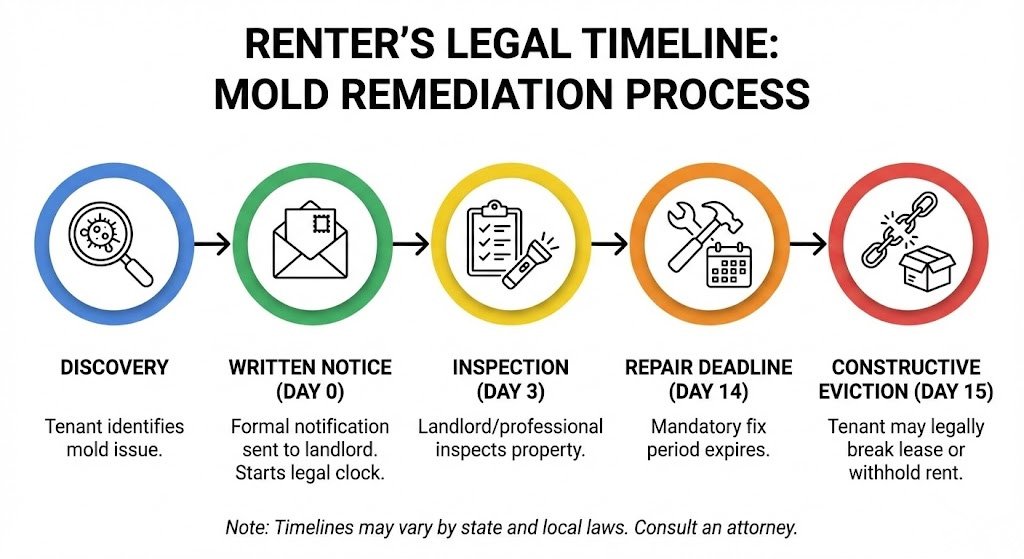
Phone calls do not exist in court. Send an email or certified letter with photos immediately.
State laws vary (usually 7-30 days) for a landlord to fix a habitability issue after notice.
If ignored, send a formal Demand Letter citing your state’s specific health code statutes.
In some states, you can hire a pro to fix it and deduct the cost from rent. In others, you must withhold rent in an Escrow account.
4. Protection Against Retaliation
A common fear is: “If I complain, will my landlord raise my rent or evict me?”
“The most common mistake I see tenants make is withholding rent WITHOUT putting it in Escrow. If you just stop paying, the judge sees ‘Non-Payment of Rent.’ If you put the money in a separate Escrow account, the judge sees ‘Leverage for Repairs.’ It is a critical distinction that wins cases.”
In most states, it is illegal for a landlord to raise rent, decrease services, or threaten eviction within a certain window (e.g., 3-6 months) after a tenant has filed a legitimate habitability complaint. This is known as “Retaliation,” and judges punish it severely.
5. Deep Dive Resources
Select a specific legal topic below for detailed statutes and templates.
Specifics on “Reasonable Time” to repair and liability for personal property damage.
How to leave without paying penalties. The “Constructive Eviction” checklist.
How to take photos that hold up in court. The importance of timestamped logs.
Downloadable Asset. A fill-in-the-blank legal template to send to your landlord today.