Why “waterproofing paint” almost always fails. The physics of positive vs. negative side pressure and the only 2 ways to truly dry a basement.
Trusted Sources: This engineering guide aligns with standards from the American Concrete Institute (ACI) and FEMA Flood Guidelines.
A wet basement is the #1 cause of indoor mold growth. But homeowners often confuse “Humidity” (water vapor in the air) with “Seepage” (liquid water entering through walls).
You cannot fix seepage with a dehumidifier, and you cannot fix humidity with a French drain. You must diagnose the physics first.
1. The Physics: Hydrostatic Pressure
Concrete is porous. It acts like a hard sponge. When it rains, the soil outside your house fills with water. This creates immense weight pushing against your foundation walls.
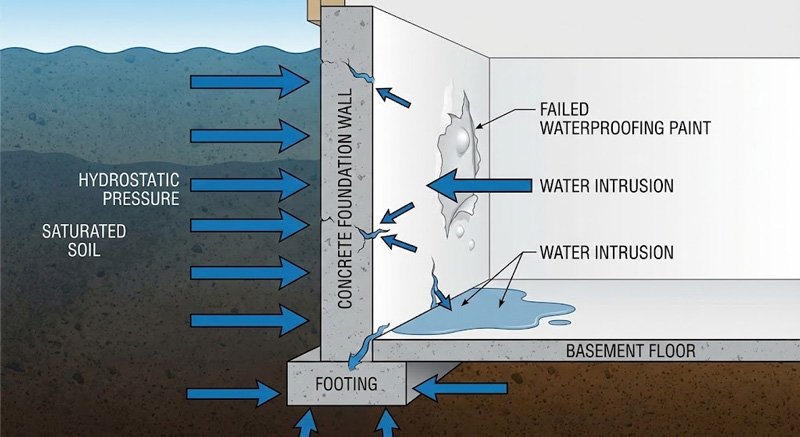
This force is called Hydrostatic Pressure. It pushes water molecules through the microscopic pores of the concrete (Capillary Action) and through cracks in the floor (the “Cove Joint”).
Key Fact: Water pressure increases with depth. This is why leaks usually happen at the bottom of the wall, not the top.
2. Why “Waterproofing Paint” Fails
Hardware stores sell thick, rubberized paints (like DryLok) that promise to stop water. This is a “Negative Side” solution, meaning you are trying to stop the water after it has already entered the wall.
The hydrostatic pressure is still there. It pushes the water behind the paint layer. Eventually, the pressure builds up enough to bubble and peel the paint off the wall, often taking chunks of concrete with it (spalling).
3. Two Real Solutions
To truly fix seepage, you either stop it outside (Positive) or manage it inside (Negative).
“Homeowners always want the $500 paint solution. But paint is cosmetic. If you have active water intrusion, paint is like putting a band-aid on a broken leg. You must relieve the water pressure, either by diverting it away from the house (gutters/grading) or by pumping it out (drain tile).”
The “Positive” Fix. You dig up the dirt around the foundation, apply a rubber membrane to the outside of the wall, and install a drain pipe. It stops water from ever touching the concrete.
The “Management” Fix. You cut a trench in the floor perimeter, catch the water, and pump it out with a sump pump. The basement stays dry, even if the walls get wet.
4. Managing Humidity (Vapor)
Even if you have no leaks, concrete naturally releases water vapor (moisture) into the air. This raises the Relative Humidity (RH).
- The Standard: Basement RH must stay below 50% to prevent mold growth.
- The Tool: You need a compressor-based Dehumidifier (70+ pints per day). Do not rely on “DampRid” bags; they are useless for large spaces.
5. The “No Carpet” Rule
We see this mistake in 90% of finished basements.
| Material | Mold Risk | Why? |
|---|---|---|
| Carpet | Extreme | Traps moisture and dust (mold food) against the cold concrete slab. |
| Hardwood | High | Wood is organic food for mold. It will warp and rot. |
| Luxury Vinyl (LVP) | Low | Plastic/Vinyl offers no food source and is waterproof. |
| Ceramic Tile | Zero | Inorganic. The safest choice for basements. |